
How Much Is Enough? Putting Your Money Jigsaw Together – Key Takeaways from Our Online Business Mastermind
Running your own business gives you freedom and flexibility, but when it comes to managing your personal finances and financial planning, it can also bring uncertainty.
Unlike a traditional salary, income from running a business isn’t always predictable. Some months are fantastic, others are quieter, and finding the balance between investing in your business, paying yourself and saving for the future can feel challenging.
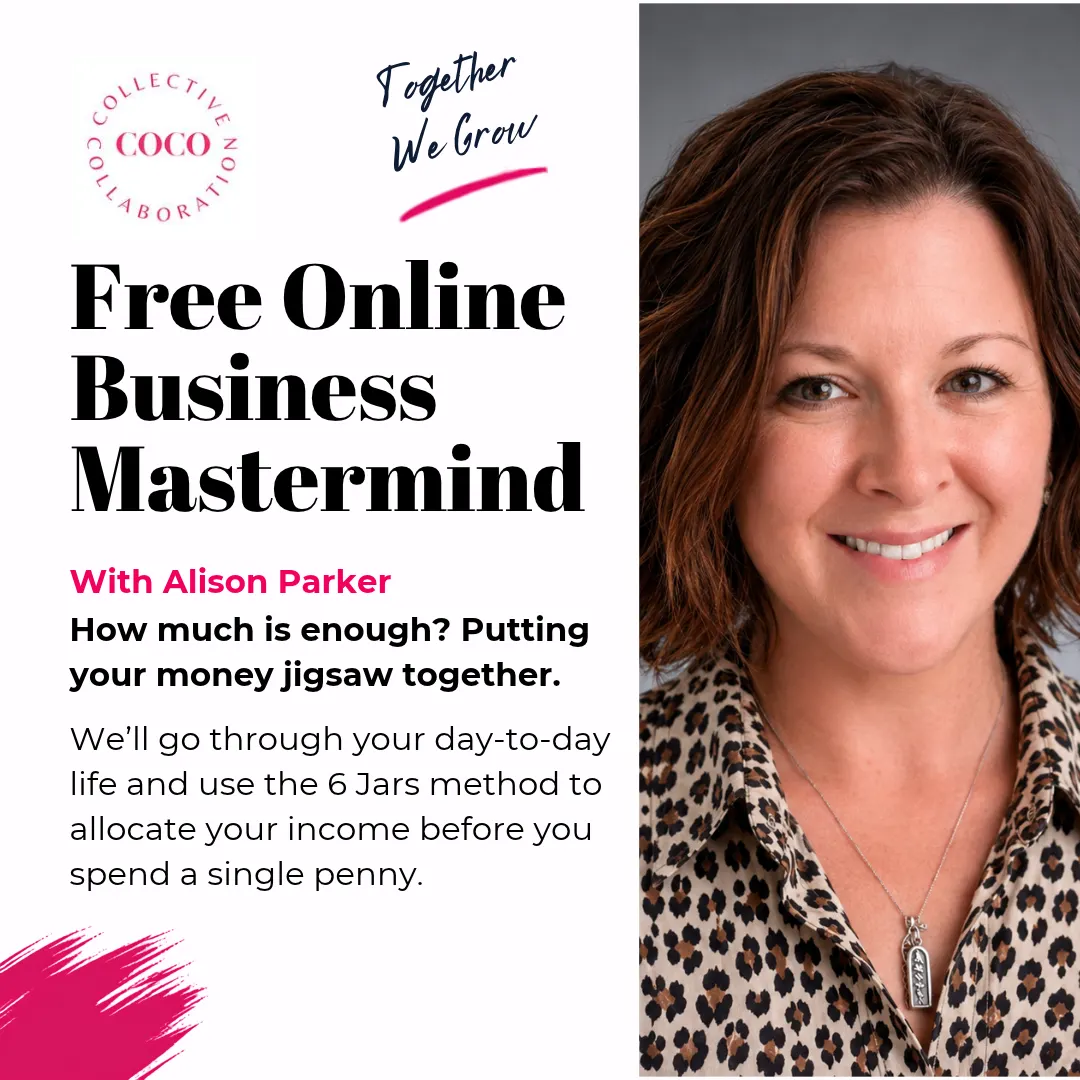
At our November COCO Women Founders Online Business Mastermind Hour, we welcomed Alison Parker from Cork Wealth to help us explore an important question:
How much money is enough, and how can we start planning for the financial future we actually want?
Alison shared practical ways to understand our spending, organise our finances and build habits that support long-term financial independence.
Here are some of the key takeaways from the session.
1. Understand Where Your Money Is Going
Before you can plan for the future, you need to understand your financial position today.
Alison encouraged us to break our personal spending into three categories:
Essentials: The everyday costs we can’t avoid, such as mortgage or rent payments, household bills, groceries, insurance and travel.
Discretionary spending: The things we choose to spend money on, including subscriptions, eating out, coffees and hobbies.
Luxuries: Larger purchases and experiences, such as holidays, home improvements or a new car.
Understanding these three areas helps identify where your money goes and whether your spending reflects your priorities.
One particularly useful point was how easily small, everyday purchases can add up without us noticing.
Alison suggested checking your banking app, as many already categorise spending automatically. You might be surprised by how much goes towards subscriptions or purchases you’ve simply stopped thinking about.
Your action: Review your last three months of personal spending and identify your essential, discretionary and luxury costs.
2. Give Every Pound a Purpose: The Six Jars Method
One of the main tools Alison introduced was the Six Jars Method, a budgeting approach that divides your income into different areas.
The idea is simple: rather than spending your money and saving whatever is left, you deliberately allocate it towards different purposes.
The example framework Alison shared was:
| Jar | Suggested allocation | Purpose |
|---|---|---|
| Necessities | 55% | Essential living expenses |
| Financial freedom | 10% | Long-term investments and pensions |
| Long-term savings | 10% | Emergency funds and future purchases |
| Education | 10% | Personal and professional development |
| Play | 10% | Enjoyment, hobbies and experiences |
| Giving | 5% | Charitable giving and supporting others |
These percentages are an aspiration, not a rigid rule.
For many business owners, essential expenses may account for considerably more than 55% of their income, particularly when household costs are high.
Alison explained that the important thing is to start with what is realistic for your circumstances and make gradual adjustments over time.
Don’t forget your play money!
One of the points we particularly liked was the importance of having money allocated for enjoyment.
Financial planning shouldn’t mean removing everything that makes life enjoyable.
Whether it’s dinner with friends, a weekend away or an activity you love, allowing yourself some spending money can make a financial plan more sustainable.
After all, we’re building businesses to support the lives we want to live, not just to pay the bills.
3. Managing Irregular Income as a Business Owner
This was a particularly relevant discussion for our COCO members.
When you run a business, you don’t always know exactly how much money you’ll receive each month.
That can make committing to regular savings or pension contributions feel difficult.
Alison suggested several ways to create more financial stability:
- Pay yourself a regular amount where possible. Rather than taking different amounts from your business every month, consider a consistent personal income based on a realistic assessment of your finances.
- Plan around a typical month. Don’t build your personal budget around your most successful month or your quietest month.
- Keep business and personal finances separate. This makes it easier to understand what your business needs and what you can afford to pay yourself, taking account of your business structure and tax obligations.
- Set aside money for tax. Make sure business tax liabilities are accounted for before deciding how much money is available for personal use.
- Build savings gradually. If you can’t commit to saving 10% of your income, start with an amount you can manage.
During the discussion, we acknowledged how difficult it can be to commit to fixed percentages when you don’t know what the next month will bring.
Alison’s response was reassuring: you don’t have to start big.
Even putting aside £5 a month can help establish a savings habit. As your business grows and your income becomes more predictable, you can review and increase that amount.
The important thing is to begin.
4. Build an Emergency Fund
Unexpected expenses are a part of life.
A boiler breaks down, the car needs repairing or your business experiences a quieter period.
Having an emergency fund can help reduce the financial pressure when these situations arise.
Alison discussed working towards a buffer equivalent to approximately two, three or six months of essential spending, depending on your circumstances.
For business owners with variable income, having this financial cushion can be particularly valuable.
If building several months of savings feels unrealistic right now, start with a smaller goal.
Your action: Work out how much you need each month to cover your essential living expenses, then consider what emergency savings target would be achievable for you.

5. How Much Money Will You Need in the Future?
One of the biggest questions Alison explored was how to calculate what we might need for retirement or financial independence.
Rather than starting with a retirement savings target, she encouraged us to think about the lifestyle we want.
Consider three different levels:
Your essential lifestyle: How much would you need each year to cover the basics?
Your current lifestyle: How much does it cost to maintain the lifestyle you enjoy today?
Your desired lifestyle: What would you like your future to look like? Perhaps more travelling, new hobbies, spending time with family or simply having the freedom to work less.
Alison introduced a simple illustration: multiplying your desired annual spending by 20 to provide an initial savings target.
For example, if you wanted £24,000 a year, multiplying this by 20 gives £480,000.
This is a broad planning illustration, not a guaranteed retirement figure. The amount someone actually needs depends on factors including retirement age, other income, inflation, investment performance and how long their savings need to last.
The exercise was useful because it encouraged us to think beyond simply having a pension.
What does financial freedom actually look like for you?
For some women, that might mean retiring completely. For others, it might mean reducing their working hours, choosing which clients they work with or having the freedom to pursue other interests.
6. Check What You Already Have
Before worrying about how much more you need to save, it’s worth understanding what you already have.
This led to an interesting discussion about old workplace pensions.
If you’ve previously been employed, you may have pension savings from earlier jobs that you’ve forgotten about.
During the session, one of our attendees realised she had a pension from her previous corporate career and logged in to check it there and then!
Alison encouraged us to review existing pensions and savings, including:
- Old workplace pensions
- Current pension contributions
- ISAs and savings accounts
- Other long-term investments
- Your State Pension forecast
If you’ve lost track of a workplace pension, the government’s Pension Tracing Service can help you find the provider’s contact details.
You can also check your State Pension forecast through GOV.UK to understand your estimated entitlement and whether there are gaps in your National Insurance record.
Alison explained that it may be possible to consolidate old pensions, but professional advice is important before transferring them because some older pensions contain valuable benefits that could be lost.
Your action: Find out what pensions and savings you already have and when you last reviewed them.
7. Think About Tax-Efficient Ways to Save
Another area Alison touched on was the importance of understanding the different ways you can save and invest for the future.
These included:
ISAs: Tax-efficient savings and investment accounts that can help you build funds for future goals.
Pensions: Long-term retirement savings that may offer tax advantages, depending on your circumstances.
Business pension contributions: If you operate through a limited company, employer pension contributions may provide tax benefits worth discussing with your accountant or financial adviser.
Investments: For longer-term goals, investing may offer opportunities for growth, although investments carry risk and can fall as well as rise in value.
Alison also highlighted the importance of understanding investment fees and how inflation can affect the future purchasing power of money held in cash.
The key message was not that everyone should choose the same financial products, but that understanding the options available can help you make more informed decisions.

8. Small Changes Can Make a Big Difference
Perhaps one of the most encouraging messages from the session was that improving your financial position doesn’t have to involve dramatic changes.
Alison talked about the power of small, incremental improvements.
If you start saving £5 a month, you might increase that to £10 when your circumstances allow.
You might review a subscription you no longer use or gradually reduce unnecessary spending.
Over time, these small changes can become positive financial habits.
And rather than trying to overhaul everything at once, Alison encouraged us to review our finances regularly.
A monthly financial check-in can help you understand whether you’re on track, what needs adjusting and how your priorities might have changed.
Your Financial Planning Wellbeing Checklist
Following the session, here are some practical actions you can take:
- Review your monthly essential, discretionary and luxury spending.
- Explore how the Six Jars Method could work for your circumstances.
- Identify a realistic amount you could start saving regularly.
- Review your emergency savings.
- Check your existing workplace pensions.
- Look up your State Pension forecast.
- Consider what financial freedom means to you.
- Schedule a monthly personal finance review.
- Speak to a qualified professional if you need personalised financial guidance.
You don’t need to tackle everything immediately. Choose one action and start there.

Don’t Forget Your Personal Financial Wellbeing
As women running businesses, we spend so much time thinking about our clients, cash flow, marketing, growth and business goals.
But how often do we give the same attention to our personal financial future?
One of the most valuable reminders from this session was that looking after your business finances and looking after your personal financial wellbeing are not the same thing.
Both deserve attention.
It was a valuable session that gave us plenty to think about and, more importantly, some practical actions to take away.
Join Our Next COCO Women Founders Business Mastermind
Our Online Business Mastermind Hours are just one of the ways we help women in business gain knowledge, share experiences and make time to work on their personal and professional growth.
Alongside our online sessions, we host regular in-person business networking and masterminds in Thame, Marlow, Beaconsfield & Amersham. As well as speed networking events, coffee mornings and workshops. COCO provides opportunities to connect with other women who understand the challenges of running a business.
Whether you’re looking for practical business advice, accountability through our 90-goal setting, fresh ideas or a supportive community, we’d love to welcome you.
Together We Grow!

Frequently Asked Questions About Financial Planning for Business Owners
How do I budget when my business income changes every month?
If you’re self-employed or running your own business, budgeting can be challenging when your income fluctuates. Start by understanding your essential monthly living expenses and, where possible, pay yourself a consistent amount based on a typical month’s income rather than your most profitable month. Keep money aside for business expenses and tax, and build an emergency fund to help cover quieter periods.
How much should a self-employed person save each month?
There’s no single amount that works for everyone. Your savings will depend on your income, living expenses and financial goals. During our COCO mastermind, Alison Parker encouraged members to start with an achievable amount, even if that’s just £5 a month. Building a consistent savings habit is more important than setting an unrealistic target that you can’t maintain.
What is the Six Jars Method for budgeting?
The Six Jars Method is a budgeting approach that divides your income into six categories: necessities, financial freedom, long-term savings, education, play and giving. A commonly used allocation is 55%, 10%, 10%, 10%, 10% and 5% respectively. However, these percentages are flexible and can be adjusted to suit your financial circumstances and priorities.
How much emergency savings should a business owner have?
An emergency fund can help cover unexpected personal expenses or periods when business income is lower than expected. During our mastermind, Alison discussed building a financial buffer equivalent to approximately two to six months of essential living expenses. The right amount depends on your circumstances, including how predictable your income is. If that target feels overwhelming, start small and build your savings gradually.
How do I plan for retirement when I’m self-employed?
Start by thinking about the lifestyle you want in retirement and how much it might cost each year. Then review your existing pensions, savings and investments to understand what you already have. If you’ve previously been employed, you may also have old workplace pensions worth checking. A qualified financial adviser can help you understand how much you may need to save and which retirement planning options suit your circumstances.
Can I make pension contributions through my limited company?
If you run a limited company, it may be possible for your business to make employer pension contributions on your behalf. These can offer tax advantages, depending on your circumstances and the applicable rules. It’s worth speaking to your accountant or financial adviser to understand whether this approach could be suitable for you and your business.

The Author: Alison Parker
Chartered Financial Planner
Alison has worked in financial services for 20 years, and in that time she has watched the profession change. Many local firms have been absorbed into large national companies, and people are finding it harder to get advice that feels personal. Alison knows how personal money is, so she co-founded Cork & Co Wealth to keep that human connection alive and easy to reach.
Cork & Co Wealth gives local, personal and independent financial advice to individuals and families. Money is about so much more than the numbers. It’s about your future, your choices and peace of mind, and about taking care of the people who matter most to you. That’s what we mean by bringing money to life.
Instead of juggling scattered pensions and old ISAs, or worrying about future tax rules on your own, we help you bring every piece of your puzzle together into one clear plan for you and your family.
If you would like guidance, you can contact Alison Parker via email – alison@corkwealth.co.uk
Disclaimer: This article shares general educational information discussed during our COCO Online Business Mastermind Hour. It does not constitute personalised financial advice. Financial products, tax rules and allowances may change, and individual circumstances vary. Please consult a suitably qualified financial adviser or accountant before making financial decisions.


